Money Chases Goods or Goods Chase Money? | Rupee 2026
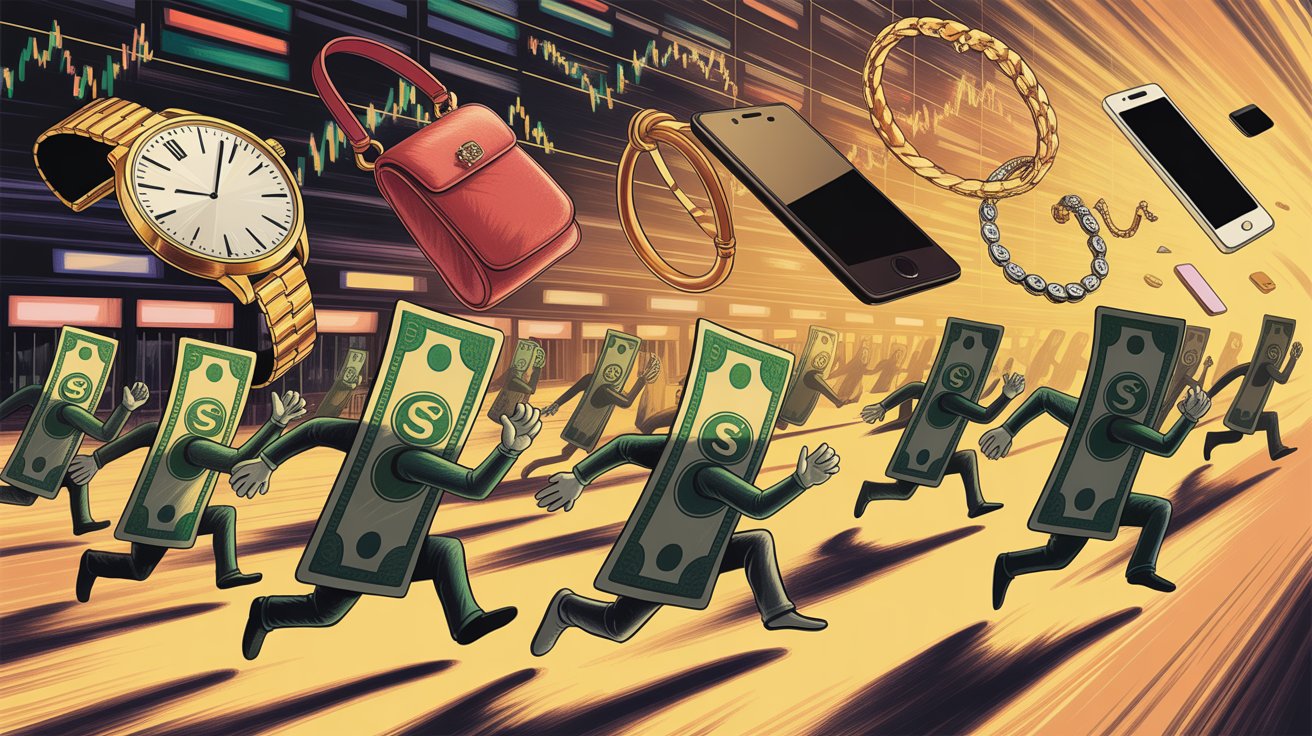
Should Money Chase Goods, or Should Goods Chase Money? The Rupee's 2026 Wake-Up Call
There's an old question hiding inside every price tag you've ever seen: should money chase goods, or should goods chase money?
It sounds like wordplay. It isn't. Whichever way that sentence runs in your economy quietly decides whether your savings grow stronger every year — or quietly leak away while you sleep. And in 2026, with the Indian rupee setting fresh record lows almost every month, the question stopped being academic.
First, the uncomfortable numbers
In March 2025, one US dollar cost about ₹85.5. By May 2026, the rupee had slipped past ₹95 to the dollar — a fall of more than 10% in roughly twelve months. Zoom out further and it gets starker: in 1947, a dollar bought ₹3.30. Today it buys around ₹95.
That is not a typo. The rupee has lost the overwhelming majority of its purchasing power against the dollar over its lifetime — and the dollar itself has been losing value the whole time too. The drivers in 2026 are real and structural: high crude oil costs, foreign investors pulling money out, trade and tariff pressure, and a wide current account deficit.
But behind all those headlines sits a deeper design choice about what money is and how it's made. That's where our question comes back.
When money chases goods (the system we live in)
In a fiat system — the rupee, the dollar, every national currency today — the supply of money can be expanded by decision. Central banks and governments can create more of it. And they do.
When the amount of money grows faster than the amount of real goods and services, you get the textbook definition of inflation: too much money chasing too few goods. Prices rise. Each note in your wallet buys a little less than it did last year.
Notice the direction of the chase. Because money is constantly being created and is constantly losing value, the rational thing to do is spend it quickly — buy the asset, the gadget, the property — before it's worth less. Money runs after goods. Economists call this a high time preference: a system that nudges everyone toward spending now and punishes patient saving.
There's a second, sneakier effect. New money doesn't reach everyone at once. Those closest to its creation — large institutions, asset holders, the well-connected — get to spend it before prices adjust. By the time it trickles down to the salaried worker or the small saver, prices have already risen. This uneven distribution has a name, the Cantillon effect, and India has felt versions of it for decades — from the squeeze of demonetisation to the slow erosion of fixed-deposit returns that barely keep pace with real inflation.
So in the world we actually live in, money chases goods. And the people holding cash — usually the ones who can least afford the loss — pay the bill.
When goods chase money (the sound-money idea)
Now flip it.
Imagine a form of money whose supply cannot be inflated at will — where the total quantity is fixed and known in advance. Gold worked roughly this way for centuries. Bitcoin pushes the idea to its logical end: a hard cap of 21 million coins, with an issuance schedule no government, company, or individual can change. (If the basics are new to you, our beginner's guide to Bitcoin walks through it without the hype.)
In a fixed-supply system, something interesting happens over time. The economy keeps producing more goods and services, but the money stays scarce. So each unit of money tends to buy more, not less, as the years pass. Prices, measured in that money, drift downward.
Watch the direction of the chase reverse. Now it pays to hold your money, because it's quietly appreciating. Sellers and producers must compete to earn that scarce, strengthening money by offering better goods at better prices. Goods chase money.
This rewards the opposite behaviour: patience, saving, building, thinking long term — what's called a low time preference. The saver is no longer the loser of the system. They're the one it's built for.
"But isn't falling prices bad?"
It's a fair pushback, and worth being honest about. Mainstream economics has long worried that if people expect prices to fall, they'll stop spending and freeze the economy. In practice, you still buy food, medicine, transport, and the phone you need — people don't starve themselves waiting for a discount. What changes is that frivolous, debt-fuelled consumption slows, while saving and productive investment speed up. Whether that's a flaw or a feature depends a great deal on which side of the savings gap you're standing on.
Sound money is also no magic wand. New monetary networks are volatile in their early decades, and learning to use them safely takes real education — which is exactly why a movement like this exists in the first place.
Why this matters for Bharat specifically
India is a nation of savers. Households park enormous value in cash, gold, and deposits — precisely the instruments that bleed value when money chases goods. A working family that diligently saves in rupees is, in effect, running up a down escalator.
India also just proved something powerful: with UPI, the country showed that hundreds of millions of people can adopt new financial technology fast when it genuinely serves them. The rails are there. The digital literacy is there. The open question is whether the money itself riding on those rails rewards the saver or quietly taxes them.
Sound money won't fix crude prices or trade deficits. But it offers individuals a way to step partly off the escalator — to hold value in something that isn't designed to dilute. And as second-layer tools mature, that value can move cheaply and instantly, not just sit still; our piece on the future of Bitcoin payments and the Lightning Network digs into how.
The question, answered
So — should money chase goods, or should goods chase money?
A system where money chases goods keeps everyone running, rewards the connected, and erodes the patient saver. A system where goods chase money slows the treadmill and pays people for building and saving.
You don't have to pick a side today. But you should at least know which system you're living in — and that the rupee's 2026 slide isn't a glitch. It's the design, working exactly as designed.
The first step isn't buying anything. It's understanding. That's the whole reason Bitcoin Bharat runs grassroots, fundamentals-first workshops across India — not speculation, just literacy. If this question got under your skin, start learning with us, or read how the movement is taking Bitcoin education beyond the metros.
Understand the money. Then decide.