The Rupee Is Not Falling. It's Failing. | Bitcoin Bharat
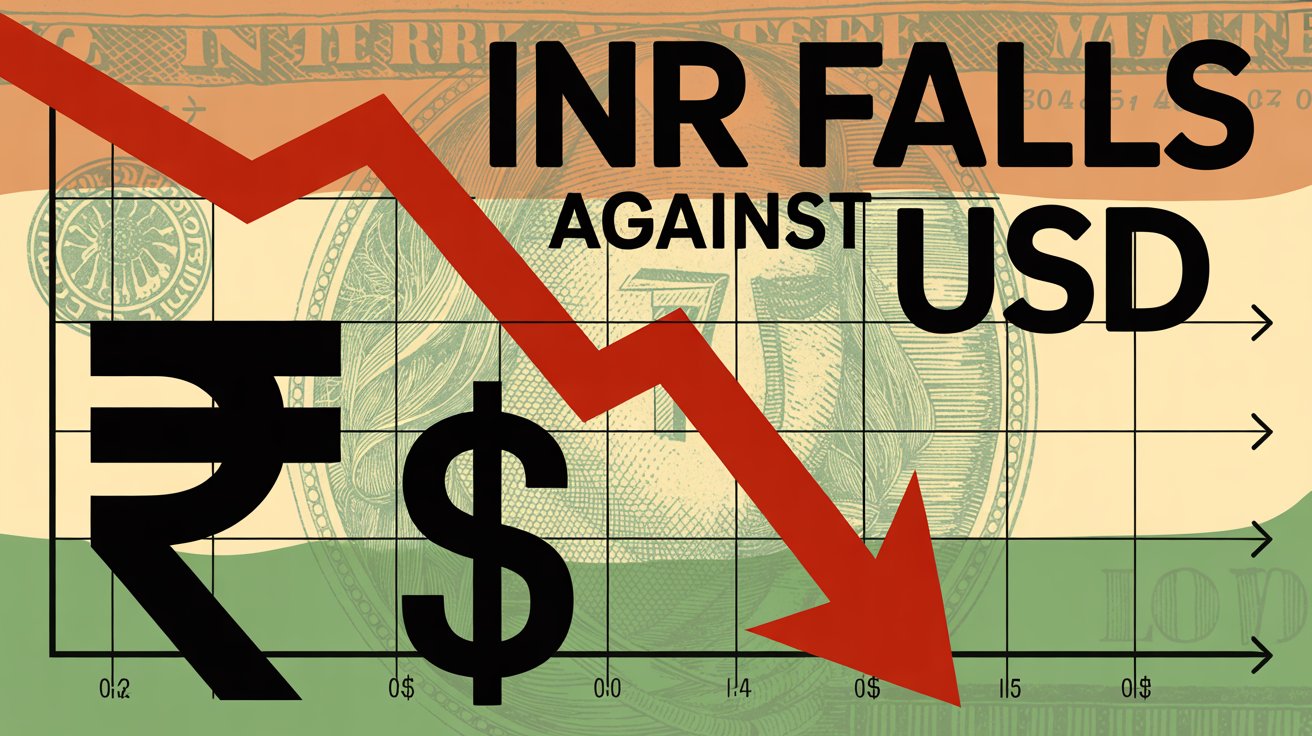
₹96.96. A Number That Should Alarm Every Indian.
On 20 May 2026, the Indian Rupee touched ₹96.96 against the US Dollar — its latest all-time low, in a sequence of all-time lows that has become almost mundane to headline writers. Almost. Because what is happening to the INR right now is not mundane — it is a slow, compounding erosion of purchasing power that every Indian household is absorbing quietly, mostly without knowing it.
USD/INR ATL | 96.96 (Hit on May 20, 2026) |
INR Decline in 2026 | 7%+ (vs USD, year-to-date) |
RBI Reserves Lost | $38B (since Feb 2026 peak of $728.49B) |
RBI Daily Burn Rate | ~$1B (per trading session) |
Let's contextualise those numbers. The rupee was at ₹83 in early 2024. It crossed ₹85 in early 2025. By December 2025, it blew past ₹91. And now, in May 2026, we are sitting dangerously close to ₹97. Each of those levels, in its time, was called an "all-time low." The IMF already noticed — it reclassified India's de facto exchange-rate regime from "stabilised" to "crawl-like." That is the international monetary community's polite way of saying: India is now formally a country that lets its currency drift downward — with occasional, increasingly expensive, attempts to slow the rate of that drift.
"The RBI aims to prevent 'sharp and disorderly' movements, not defend a specific level. But when every level becomes the new floor, the distinction starts to feel academic." — IMF reclassified India's exchange regime from "stabilised" to "crawl-like" in 2025
The worst-performing Asian currency two years in a row. That is the 2024–2025 INR's epitaph. And 2026 is shaping up to be a trilogy nobody asked for.
The Perfect Storm: Crude, Capital Flight & a Dollar That Refuses to Weaken
To understand why the rupee is where it is, you need to understand that this isn't one crisis — it's three crises arriving simultaneously, each making the other worse.
Trigger #1 — The Crude Oil Catastrophe
Brent crude has surged 57% since the start of 2026, from below $70 to a range of $109–$111 per barrel, driven by the Iran conflict and Strait of Hormuz geopolitical tension. India imports 85–88% of its crude oil requirements in US dollars. Every single dollar increase in crude price adds approximately ₹17,000 crore to India's annual import bill. At $111 versus $70, India's crude import cost has increased by approximately $60 billion on an annualised basis — a current account shock of historic proportions that structurally overwhelms the RBI's intervention capacity.
Oil marketing companies — IOC, BPCL, HPCL — are now buying $3–$4 billion per month in dollar-denominated crude settlements, replacing FII equity outflows as the primary mechanical driver of rupee weakness. Every barrel India imports is a vote against the rupee.
Trigger #2 — Capital Flight at Scale
Foreign portfolio investors have sold approximately $18 billion in Indian equities so far this year. This is a familiar pattern: when US bond yields sit around 5%, global capital finds the safety of American treasuries far more attractive than the volatility of emerging markets. A weaker rupee amplifies this — it makes dollar-denominated returns look even better by comparison, creating a self-reinforcing cycle of outflow and depreciation.
Trigger #3 — A Structurally Strong Dollar
The US Federal Reserve has not eased aggressively enough to weaken the dollar meaningfully. Strong payroll data has kept the dollar elevated. This isn't India's fault exclusively — virtually every emerging market currency is under pressure. But the INR's exposure to crude oil makes it uniquely vulnerable in this particular environment.
The RBI's Playbook: Expensive, Exhaustible, and Increasingly Ineffective
The Reserve Bank of India is not sitting idle. It has deployed essentially every tool in its arsenal. But here's the honest assessment: it is slowing the decline, not reversing it. And every tool it uses comes with a cost.
Jan 2025 — $3B Rupee Liquidity Injection RBI injected ~$3B worth of rupee liquidity via dollar-rupee swap operations to address banking system tightness.
Dec 2025 — $5B USD/INR Buy-Sell Swap Announced RBI announced a $5B swap auction. The rupee still fell 13 paise the same day to ₹89.98. The market shrugged.
Jan 2026 — $2B+ in FX Swaps Over $2B in forex swaps conducted to inject rupee liquidity into a banking system running dry from prior interventions.
Q3 2025 — Only $10.9B Spent on Defence A sharp retreat from the $38B spent in Q4 2024. The RBI signalled a pivot — allowing more depreciation as a shock absorber.
May 2026 — ~$1B/Day Dollar Sales + New $5B Swap (May 26) RBI selling dollars at an estimated $1B per day in recent trading sessions. On May 20, announced another $5B buy-sell swap for May 26. Forex reserves down to $690B from a February peak of $728B.
The arithmetic here is unforgiving. India's forex reserves stand at $690.69 billion as of May 2026, down from a peak of $728.49 billion in February — a drawdown of over $38 billion in roughly 90 days. At a burn rate of $1 billion per trading session, that reserves cushion is a depreciating asset in two senses: it is shrinking in absolute terms, and its purchasing power in the currency war is falling too.
"The RBI is essentially controlling the speed of the move — not its direction. Oil still high. Dollar strong. FPI outflows continuing. Central banks can temper volatility, but currency movement is ultimately driven by fundamentals." — FX Leaders Analysis, May 2026
Major banks have already revised their forecasts upward. DBS Group Research now targets a USD/INR range of 95–100 for the rest of 2026 — a significant upward revision from their earlier 90–95 projection. Kedia Advisory sees a possible range of ₹91.70 to ₹99.50 over the next six months. The direction of expert consensus is unambiguous.
What the Government Told You — and What It Didn't
In the middle of all this, Prime Minister Modi urged Indian citizens to adopt austerity measures — save fuel, avoid foreign travel, and refrain from buying gold for at least a year. The ostensible reason: conserve foreign exchange, which is under pressure from the West Asia war.
We explored the deeper implications of that appeal in an earlier piece: Modi Asked Indians to Stop Buying Gold for a Year. Here's What He Didn't Say. — The ask was framed as patriotic austerity. But read between the lines: the government is essentially admitting that Indian demand for hard assets is a problem for its fiat balance sheet.
This is the pattern that repeats across monetary history. When a fiat currency is under stress, governments don't fix the root cause — they restrict your access to the alternatives. Gold import duty was hiked to 15% on May 13, 2026. Foreign travel is discouraged. The implicit message is: stay in rupees. Keep your savings in the instrument that is losing value. Trust the system.
The government is simultaneously admitting that the rupee is in trouble and asking you not to hedge against it. That contradiction deserves to be named clearly.
The Structural Problem No Intervention Can Fix
Here is the macro reality that every Indian saver needs to understand: India is a structural net importer. Crude oil, electronics, and gold dominate the trade deficit. The current account deficit is expected to widen to 1.7–2.0% of GDP in FY2026 — Goldman Sachs projects $37 billion. These are not temporary pressures. They are the arithmetic of India's import dependency meeting a world of dollar-denominated commodity pricing.
The RBI's Flexible Inflation Targeting framework mandates 4% inflation. But when your currency weakens and 85% of your crude is priced in foreign currency, inflation is imported automatically. The RBI faces a genuine trap: raise interest rates to defend the rupee and you suppress economic growth; let the rupee slide and you import inflation. There is no costless option. Every move is a trade-off, and ordinary Indians pay in every scenario — either through stagnant growth or through eroding purchasing power.
The Reserve Depletion Problem
India's $690 billion in reserves covers roughly 10–11 months of imports, generally considered a comfortable buffer. But consider what happens as that buffer shrinks: derivative-related obligations from earlier currency interventions are estimated at $103 billion. The RBI has reportedly sold over $100 billion in spot and forward markets during 2025–26 alone. These forward positions create future obligations that further constrain the central bank's room to manoeuvre.
To borrow the language of Bitcoin: the RBI's intervention strategy is not a long-term solution. It is a time preference problem. Spending reserves today buys short-term stability at the cost of long-term capacity. And unlike Bitcoin's hard cap, there is no transparent, auditable accounting of exactly what the RBI owes in its forward book.
What This Means for Your Savings — Whether You Know It or Not
Most Indians do not hold dollars. They hold rupees — in savings accounts, fixed deposits, provident funds, and life insurance policies denominated in INR. Every percentage point of rupee depreciation is a percentage point of real purchasing power lost on those savings. The 7%+ depreciation in 2026 alone represents a silent tax on every rupee you hold.
Fixed deposit rates, currently in the 6–7% range for most banks, are barely keeping pace with official CPI — and official CPI does not fully capture the cost of imported goods and energy that ordinary households actually consume. In real terms, many Indian savers are losing ground every single year, not gaining it.
"The rupee lost over 5% of its value in 2025, was the worst-performing Asian currency that year, and is on track to repeat that title in 2026. This is not noise. This is signal." — FXStreet Annual Currency Analysis, December 2025
The conventional advice — save in FDs, invest in gold (but now the government says don't), keep an emergency fund — is built on the assumption that your base currency is roughly stable in value. That assumption deserves scrutiny. The INR's multi-decade depreciation trajectory makes it increasingly difficult to justify.
Bitcoin: A Different Kind of Reserve
We are not here to tell you that Bitcoin solves everything overnight, or that holding sats eliminates all financial risk. We are here to make an argument that a Bitcoiner and a finance researcher would both find hard to dismiss:
Bitcoin has a fixed supply of 21 million. No central bank can announce a $5 billion swap and dilute it overnight. No government can impose a 15% import duty on it. No crude oil shock can structurally increase the cost of acquiring it against a weakening base currency. It is not subject to a current account deficit. It has no forward book of derivative obligations. Its inflation schedule is algorithmic, transparent, and immutable.
Contrast that with the rupee, whose value is set by a combination of: global commodity prices India does not control, capital flows driven by decisions made in New York and Washington, RBI interventions of uncertain magnitude and duration, and government policies that change at will — including asking you to stop buying the one physical hard asset Indians have trusted for thousands of years.
When you buy Bitcoin, you are opting out of that system — not into a risk-free alternative, but into a system governed by math and consensus rather than committees and reserve drawdowns. For Indians watching the rupee hit new all-time lows with increasing regularity, the asymmetry of that choice deserves serious consideration.
The government is worried about gold imports draining forex reserves. It is worried about capital flight. What it is essentially expressing is a preference for you to remain exposed to rupee-denominated assets while the rupee depreciates. Bitcoin is the one asset in existence that cannot be restricted by a duty hike, cannot be seized at the border, and cannot be debased by a swap auction.
The Chart Doesn't Lie. The Trend Is the Message.
In 2001, USD/INR was around ₹47. In 2013, it was ₹57. In 2018, ₹69. In 2022, ₹83. Today: ₹96.96 and climbing. This is not a crisis. This is a trend. A trend that has been in place across governments of different political stripes, across different RBI governors, across booms and busts. The rupee's secular depreciation against the dollar is not a policy failure so much as a structural feature of being an import-dependent developing economy tied to a reserve currency you do not control.
The RBI's interventions — dollar sales, FX swaps, rate cuts, rate hikes, swap windows for oil companies — have slowed various episodes of this trend. None has reversed the underlying direction. The IMF has noticed. DBS, Goldman, Kedia — they have all revised their forecasts upward. The rupee's medium-term trajectory, absent a dramatic structural shift in India's energy import dependency or a sustained dollar bear market, points toward further weakening.
"The rupee is not falling. It is failing — slowly, structurally, and at an accelerating pace. And the tools being used to manage that failure are themselves finite and depleting. The honest question every Indian saver should ask is: what is the long-term plan for your purchasing power?" — Bitcoin Bharat Research Desk
We don't believe the answer to that question is to trust a system that asks you not to buy gold while burning a billion dollars a day defending a currency whose depreciation is, at this point, a matter of historical record.
Stack sats. Verify the math. Stay sovereign.