Modi Asked Indians to Stop Buying Gold for a Year. Here's What He Didn't Say.
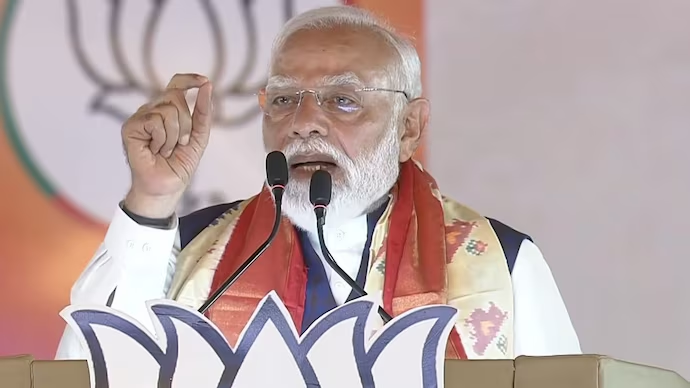
On a stage in Hyderabad on May 10, the Prime Minister of India did something unusual. He asked the people of a country that has bought gold for two thousand years - at births, weddings, festivals, and funerals - to stop. For one full year. No new jewellery. No coins. No bars.
The reason, he said, was patriotism.
"Patriotism is not only about the willingness to sacrifice one's life on the border. In these times, it is about living responsibly and fulfilling our duties to the nation in our daily lives." - PM Narendra Modi, Hyderabad, May 10, 2026
It's a beautifully framed appeal. It's also, if you read between the lines, one of the most revealing economic statements an Indian Prime Minister has made in years. And for those of us who think about money for a living - specifically, sound money - it tells you everything about where the rupee stands today, and why a generation of Indians is going to discover Bitcoin the hard way.
Let's break down what's actually happening.
The numbers behind the appeal
This wasn't a moral campaign. It was a balance-of-payments rescue dressed up as a civic ask.
India's foreign exchange reserves have fallen to roughly $691 billion, down from $728.5 billion in late February - a drop of nearly $38 billion in about ten weeks.
The rupee has slid to a record low of 95.63 against the US dollar.
India imports nearly 85–89% of its crude oil. When Brent jumped from around $70 to over $113–$126 a barrel after the US–Iran war began on February 28, the country's import bill exploded.
India's gold import bill hit roughly $72 billion in FY26, more than double the $35 billion of FY23.
India produces almost no gold domestically. Every gram you and I buy is paid for in US dollars, settled offshore.
That last sentence is the entire story.
The government isn't asking you to stop buying gold because gold is bad. The government is asking you to stop buying gold because gold is bought in dollars, and India is running out of dollars.
The quiet contradiction nobody wants to talk about
Here's the part that should sit uncomfortably with every Indian saver: while the citizen is being asked to abstain, the Reserve Bank of India is doing the exact opposite.
The RBI now holds around 880 tonnes of gold, with more than two-thirds - roughly 680 tonnes - quietly repatriated and stored within India over the past several years. Gold's share of India's total forex reserves has climbed from about 13.92% to 16.7%.
Read that again. The central bank is accumulating gold. The Prime Minister is asking you not to.
This isn't hypocrisy. It's strategy. The RBI knows what every Indian grandmother has always known - that paper money loses value over time and that gold doesn't. The RBI also knows that when the dollar system is under stress, neutral reserve assets matter more than promises printed on paper.
So the message, decoded, is this: the state will hold the hard money. The citizen will hold the rupee.
That's not a Bitcoin opinion. That's just what the data says.
The Indian saver isn't the problem - the system is
Indians don't buy gold because they're irrational. Indians buy gold because, over the lifetime of any working adult in this country, the rupee has lost a staggering amount of purchasing power. A gram of gold cost a few hundred rupees in the 1990s. Today it crosses ten thousand. That isn't gold becoming more valuable. That's the rupee becoming less.
The household instinct to convert depreciating paper into something that holds its worth is not greed. It is financial self-defense.
What's being labelled as a "patriotic sacrifice" is, in plain terms, a request that Indians voluntarily hold an asset (the rupee) that the state itself is unable to defend without their cooperation. The asset losing value is being protected by the people losing wealth.
A Bitcoiner reading this sees the pattern immediately. It's the same pattern that has played out in Argentina, in Turkey, in Lebanon, in Nigeria. First, a currency weakens. Then, the citizens flee to hard assets. Then, the state asks them - politely at first - to stop.
What comes after the polite phase is what we should be paying attention to.
Why this matters for Bitcoin in India
Gold has one fatal flaw as a household savings asset in 2026: it has to be imported, and importing it depletes the same forex reserves the country is trying to defend. Every wedding gold purchase in Mumbai sends dollars to London, Zurich, or Dubai. Every coin bought during Dhanteras worsens the current account deficit. Conservative estimates suggest even a 30–50% reduction in gold imports could save India between $20–36 billion annually in foreign exchange.
Bitcoin doesn't have this problem.
A Satoshi bought by an Indian saver does not require the country to part with a single dollar of forex reserves in the macroeconomic sense that gold does. It does not need to be physically imported. It cannot be lost in transit, melted by a jeweler, or undervalued at a pawnshop. It settles peer-to-peer, instantly, globally, on a network that does not care about the Strait of Hormuz or what the rupee did against the dollar this morning.
For a country that is structurally short on dollars and structurally long on savers, this is not a small thing. It is, potentially, an exit door from the exact trap the Prime Minister was describing.
That doesn't mean every Indian should suddenly stop buying gold and rotate into BTC. Gold has cultural weight, generational meaning, and a five-thousand-year track record. But the Bitcoiner's argument is simpler: if the goal is to escape the slow bleed of the rupee, gold and Bitcoin are partners, not rivals. One is heavy, ancient, and easy for the state to track. The other is weightless, new, and harder to confiscate.
In a hyperbitcoinized future, India wouldn't be having a forex crisis every time the Middle East caught fire. It would be holding a portion of its national savings in an asset that doesn't depend on any single government, any single currency, or any single shipping lane.
The warning Bitcoiners should not miss
There's a darker reading of this moment too, and it would be dishonest not to mention it.
Every time a government has asked its citizens to stop buying a particular form of savings, history shows the next step is usually to make them stop. India has done this before - the Gold Control Act of 1968 under Morarji Desai outright banned private gold holding in many forms. Import duties on gold have been raised repeatedly through every forex crunch since.
If gold curbs return - higher import duties, tighter LRS limits, additional KYC at jewellers - Indian Bitcoiners should not assume crypto will be spared. The same mindset that sees household gold as a "dollar drain" can just as easily reframe self-custodied Bitcoin as a "capital flight risk." The legal infrastructure for that argument is already partly in place.
The lesson is not panic. The lesson is sovereignty. Learn self-custody. Understand seed phrases. Don't keep everything on Indian exchanges. Don't wait for a circular to teach you what UTXOs are.
The honest takeaway
PM Modi's appeal is not unreasonable. India is in a real squeeze. Oil is expensive, the dollar is strong, FIIs have pulled nearly ₹1.97 lakh crore out of Indian markets between January and May, and the rupee is genuinely under pressure. Asking citizens to be conscious of forex outflows in this environment isn't villainous - it's pragmatic.
But the deeper truth, the one a Bitcoiner can't help noticing, is that this is the cost of building national savings on a foundation we don't control. As long as the world settles oil in dollars, prices gold in dollars, and treats the rupee as a secondary currency, every external shock will land on the Indian household first.
Gold is the symptom. The dollar standard is the disease.
Bitcoin is the only opt-out that doesn't require asking permission.
For one year, the Prime Minister has asked Indians to skip the gold counter. Use that year wisely. Read. Learn. Stack sats. Understand the difference between an asset the state can ask you to stop buying, and an asset the state can't even see.
The next time forex reserves crack, the question won't be should we have bought less gold?
It will be why didn't we own anything that doesn't need dollars in the first place?