What Is Digital Credit? How Bitcoin Is Becoming the Collateral Layer of a New Financial System

For centuries, the architecture of credit has rested on the same foundation: trusted collateral. Roman merchants pledged land. Medieval banks lent against gold. Modern financial institutions post sovereign bonds as the bedrock of overnight lending markets. In each era, the asset that anchors credit is the one the market agrees is hardest to destroy, easiest to verify, and most universally accepted.
Bitcoin is now entering that conversation not as a speculative instrument, but as a new form of pristine collateral. And from that foundation, an entirely new category of financial infrastructure is emerging: Digital Credit.
Defining Digital Credit
Digital Credit refers to the full spectrum of credit instruments, lending structures, and capital markets products that use Bitcoin as their primary collateral or reserve asset. It is not a single product or protocol it is a financial system layer, built on top of the hardest monetary asset ever created.
Just as sovereign bonds underpin the repo markets and money markets that fuel the traditional financial system, Bitcoin is beginning to underpin a parallel credit architecture one that is global, programmable, and open by design.
Digital Credit includes Bitcoin-backed loans, convertible bonds issued against Bitcoin treasury positions, preferred stocks and structured credit products that use Bitcoin collateral to generate yield and manage institutional risk. Taken together, these instruments form the building blocks of what will become fully realized Bitcoin capital markets.
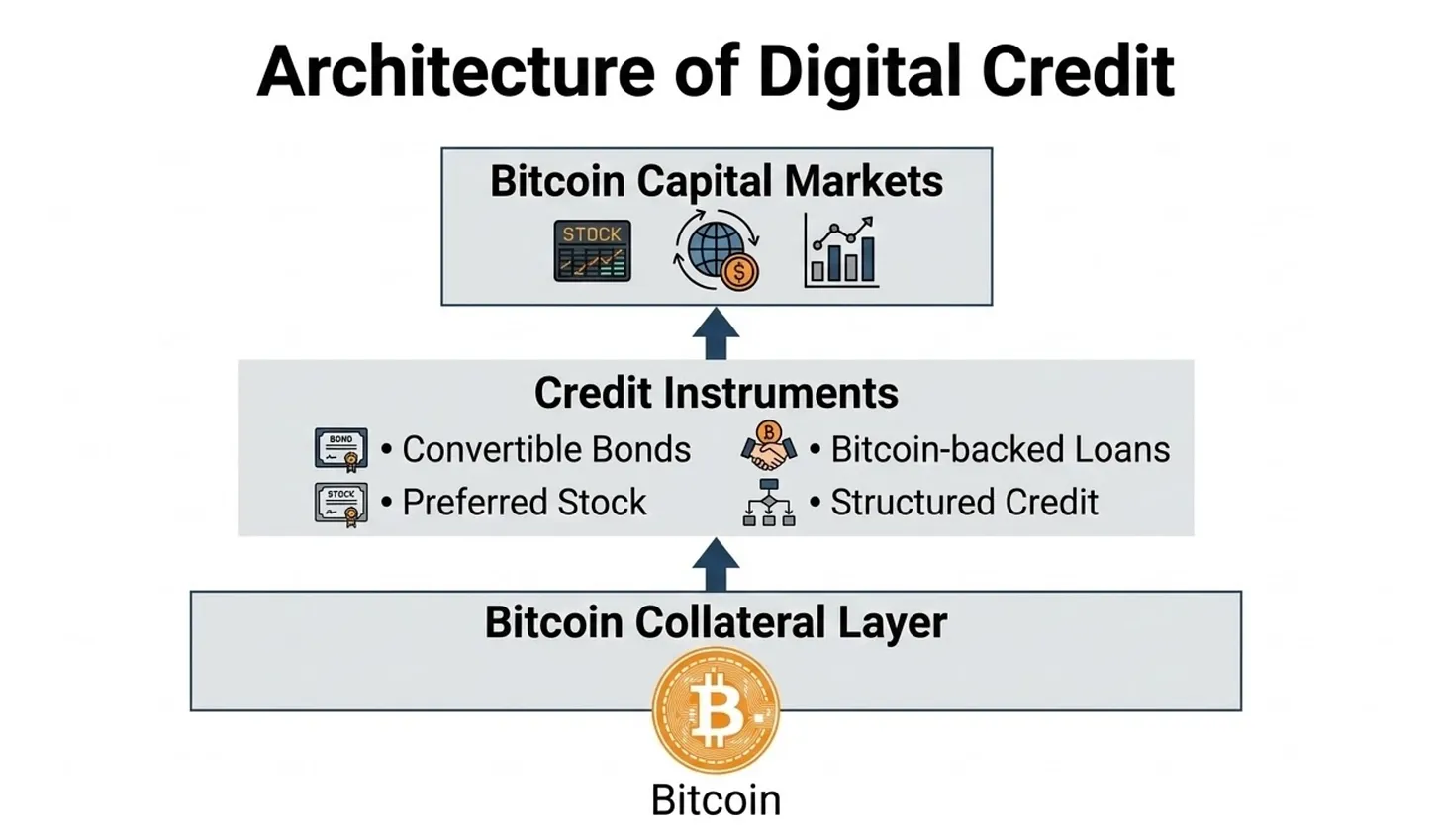
Four-layer system diagram: Bitcoin collateral underpins lending markets, credit instruments, and Bitcoin capital markets.
Why Bitcoin Works as Collateral
Not every asset earns the designation of pristine collateral. To serve as the base layer of a credit system, an asset must be scarce, liquid, portable, transparent, and settleable at any time, in any jurisdiction.
Bitcoin satisfies each of these conditions in ways no prior asset has managed simultaneously:
Scarcity: A hard cap of 21 million bitcoin, enforced by mathematical consensus, makes it the only asset with a supply schedule that cannot be altered by any government, central bank, or corporate decision.
Global liquidity: Bitcoin trades continuously across every major geography, with deep markets operating around the clock.
Portability: Unlike gold or real estate, Bitcoin can be moved anywhere in the world in minutes, without intermediaries.
Transparency: Every unit of Bitcoin collateral can be cryptographically verified on a public ledger, eliminating the opacity that makes traditional collateral disputes costly and slow.
Censorship resistance: No single counterparty can freeze, confiscate, or devalue Bitcoin-backed collateral through political or institutional action.
24/7 settlement: Unlike bond markets or equities, Bitcoin settles continuously Bitcoin-backed lending can be margined, liquidated, and restructured in real time.

INFOGRAPHIC · WHY BITCOIN WORKS AS COLLATERAL
Radial diagram: six collateral properties Scarcity, Global Liquidity, Portability, Transparency, Censorship Resistance, 24/7 Settlement.
These properties, taken together, make Bitcoin uniquely suited to serve as the collateral foundation for a new generation of credit markets.
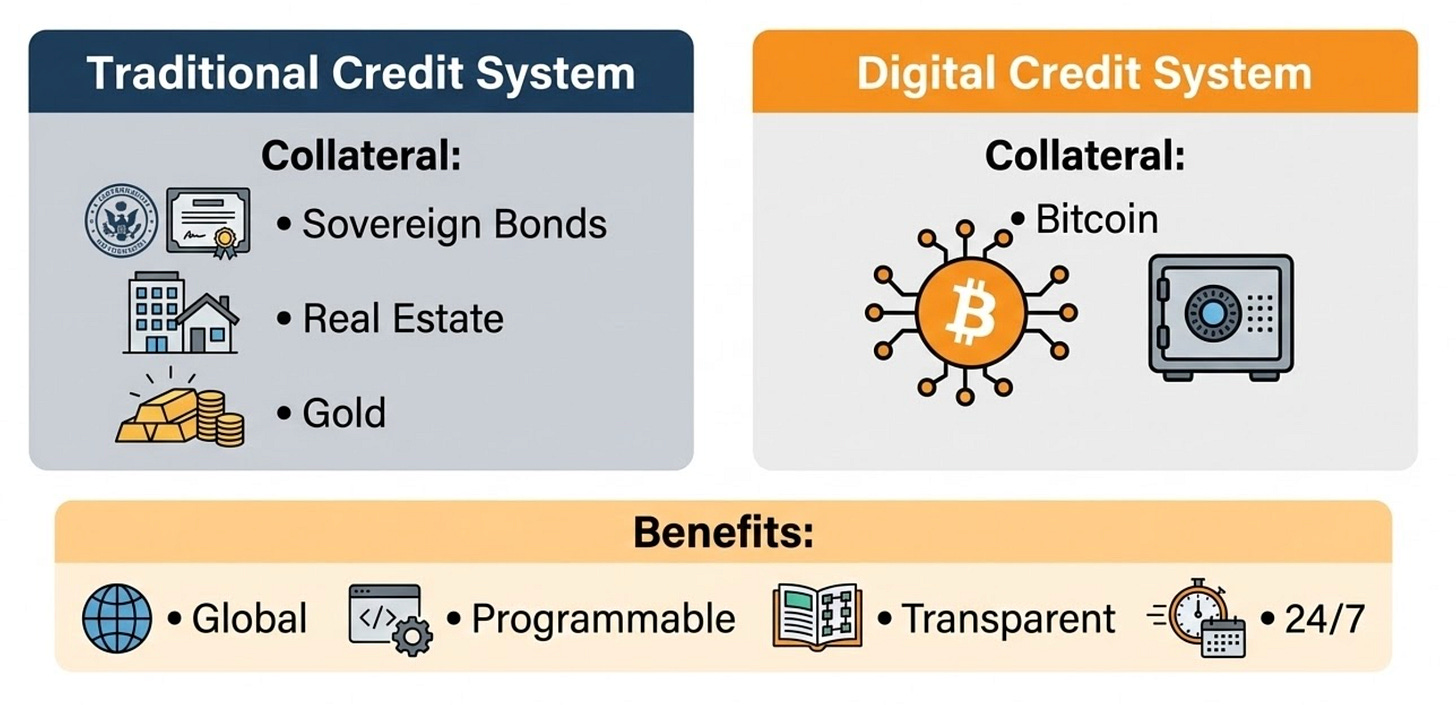
INFOGRAPHIC · TRADITIONAL VS. DIGITAL CREDIT
Side-by-side comparison: sovereign bonds, real estate, and gold (traditional) versus Bitcoin collateral global, programmable, transparent, and always open.
The Credit Structures Being Built on Bitcoin
The emergence of Bitcoin-backed lending is only the first chapter. As institutional adoption deepens and the legal and financial infrastructure matures, a far richer set of credit instruments is taking shape.
Companies holding Bitcoin on their balance sheets are beginning to issue convertible bonds backed by Bitcoin treasury positions giving investors a fixed-income instrument with asymmetric upside exposure. Others are raising capital through preferred stock issuances secured by Bitcoin reserves, creating hybrid instruments that sit between debt and equity in the capital structure. And at the more sophisticated end of the market, financial engineers are beginning to construct structured credit products that pool Bitcoin collateral to generate tranched risk exposure echoing the mortgage-backed securities and CDO structures of traditional finance, but built on a far more transparent and verifiable asset base.
Meanwhile, corporate treasury strategies that use Bitcoin leverage to amplify holdings pioneered publicly by a handful of companies are becoming a recognized financial playbook. These strategies are drawing serious attention from institutional capital allocators and credit analysts, not as speculation, but as a form of Bitcoin-native corporate finance.
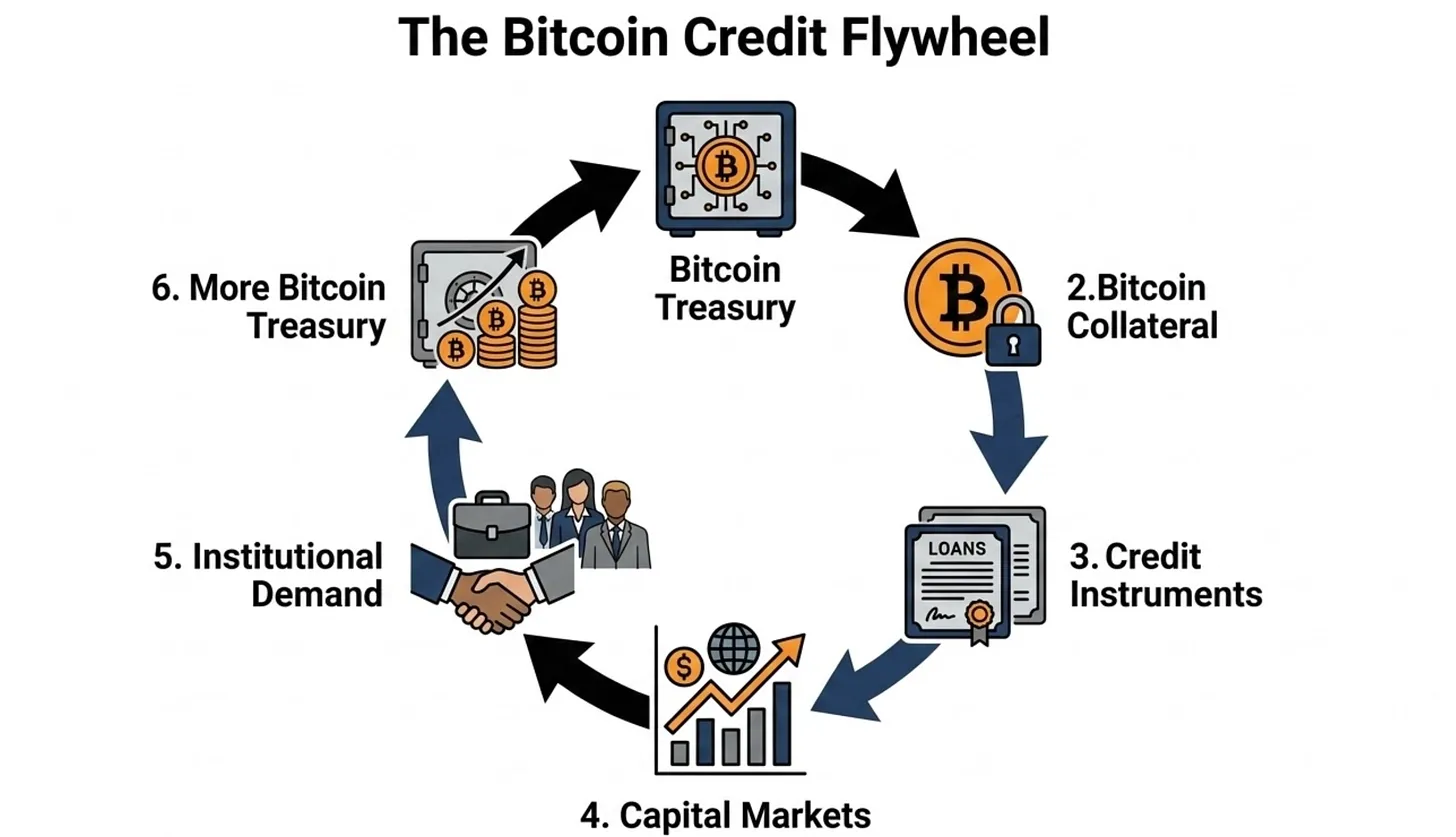
INFOGRAPHIC · THE BITCOIN CREDIT FLYWHEEL
Circular flywheel: Bitcoin Treasury → Bitcoin Collateral → Credit Instruments → Capital Markets → Institutional Demand → back to Bitcoin Treasury.
A Structural Shift, Not a Speculative Trend
What is unfolding in Bitcoin capital markets is not a niche experiment or a crypto-adjacent curiosity. It is a structural evolution in how credit is created, collateralized, and distributed.
Every mature financial system is built on a trusted collateral asset. The question for the 21st century is not whether digital collateral will exist, but which asset will anchor it. Bitcoin’s scarcity, verifiability, and borderless liquidity position it as the most credible answer.
“Digital Credit is not a trend. It is the beginning of a new financial layer and the infrastructure being built on top of Bitcoin today will define how capital flows for decades to come.”