How Does Bitcoin Work? A Simple Breakdown for New Users
How Does Bitcoin Work? A Simple Breakdown for New Users
Introduction
Bitcoin often sounds confusing to first-time users. Words like “blockchain,” “mining,” and “digital wallets” can make it feel technical or intimidating. But at its core, Bitcoin is simply a new way to send and store money without relying on banks or middlemen.
Understanding how Bitcoin works helps you trust it more and use it safely. Instead of being controlled by one company or government, Bitcoin runs on a shared system that anyone can verify. This transparency is what makes it unique.
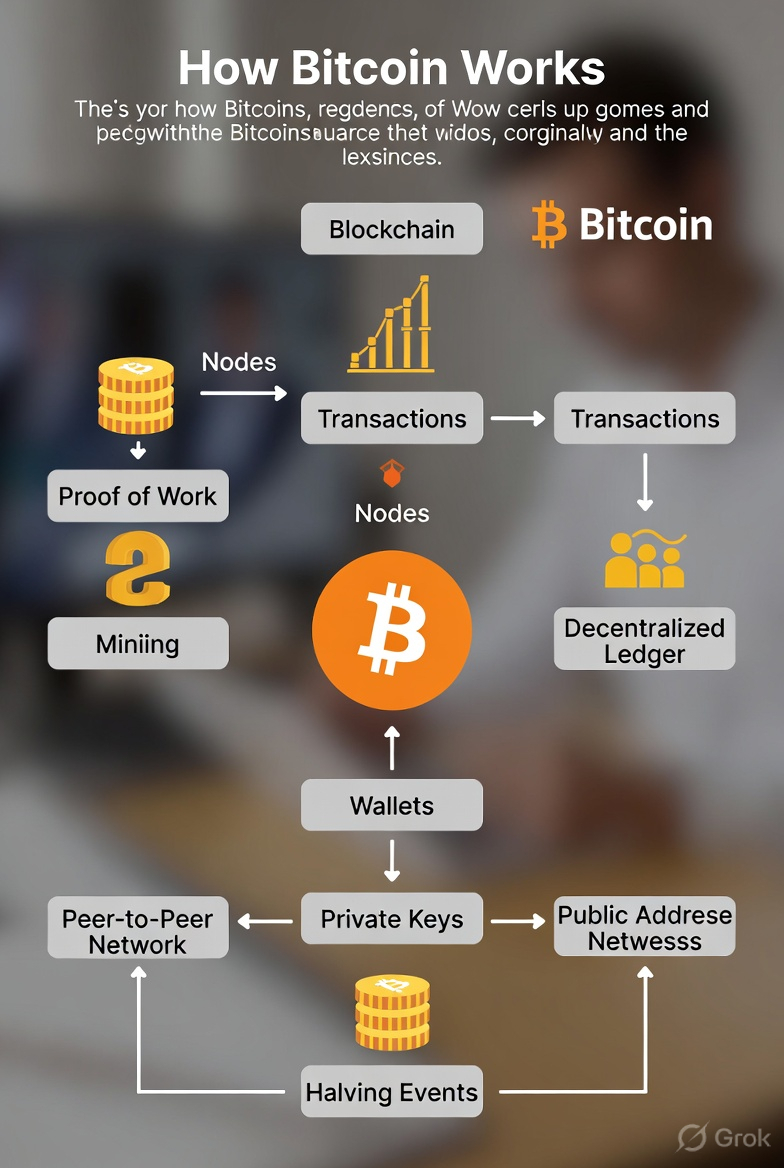
In this guide, we’ll break down how Bitcoin works in plain language. You’ll learn the Bitcoin mechanics, the basics of the blockchain, how transactions move from sender to receiver, and how mining keeps the system running , all without technical jargon.
How Bitcoin Works at a High Level
Before diving into details, let’s look at the big picture.
Bitcoin is a digital currency that allows people to send value directly to one another over the internet. Instead of a central authority keeping records, Bitcoin uses a public system where transactions are verified by a global network of computers.
Here’s what makes Bitcoin different:
No single owner or controller
Transactions are transparent and verifiable
Users can hold and manage Bitcoin themselves
This system is what enables Bitcoin to work independently and reliably.
Blockchain Basics: The Foundation of Bitcoin
At the heart of Bitcoin mechanics is something called the blockchain.
A blockchain is a public digital record of all Bitcoin transactions. Think of it like a shared notebook that anyone can view, but no one can secretly change.
Each “block” contains:
A group of recent transactions
A timestamp
A link to the previous block
Once a block is added, it becomes part of a chain that goes all the way back to the first Bitcoin transaction.
Why this matters:
It prevents double spending
It ensures transparency
It makes past transactions nearly impossible to alter
Image URL: https://commons.wikimedia.org/wiki/File%3ABitcoin_Block_Data.png?utm_source=chatgpt.com
Image credit: Wikimedia Commons (CC0 / Public Domain)
Transaction Process Explained: Sending and Receiving Bitcoin
When you send Bitcoin, you’re not moving physical coins. You’re updating the blockchain to show that ownership has changed.
Here’s the transaction process explained step by step:
You enter the receiver’s Bitcoin address
Your wallet signs the transaction using your private key
The transaction is broadcast to the Bitcoin network
Network participants verify the transaction
It gets added to the blockchain
Once confirmed, the transaction becomes permanent.
Important things to know:
Transactions are transparent but not tied to real names
Once confirmed, transactions cannot be reversed
You don’t need permission from anyone to send Bitcoin
Image URL: https://commons.wikimedia.org/wiki/File%3ABitcoin_Transaction_Visual.svg?utm_source=chatgpt.com
Image credit: Wikimedia Commons (CC0 / Public Domain)
Mining Introduction: How Bitcoin Stays Secure
Mining is one of the most misunderstood parts of how Bitcoin works.
Bitcoin mining is the process that:
Confirms transactions
Adds new blocks to the blockchain
Keeps the network secure
Miners use computers to solve mathematical puzzles. When a miner solves one, they earn the right to add the next block.
Why mining matters:
It prevents fraud
It keeps the network decentralized
It ensures no one can easily rewrite history
Mining also introduces new Bitcoin into the system in a predictable way, following fixed rules that everyone can see.
Why Bitcoin Doesn’t Need a Central Authority
Traditional money systems rely on trusted institutions to approve transactions and maintain records. Bitcoin replaces that trust with math and transparency.
Because the blockchain is public:
Anyone can verify transactions
No single entity can control the ledger
Rules are enforced by the network itself
This design is what allows Bitcoin to operate globally, 24/7, without needing permission.
Common Mistakes New Users Make
When learning how Bitcoin works, beginners often make a few avoidable mistakes:
Thinking Bitcoin is anonymous (it’s transparent, not hidden)
Confusing wallets with accounts
Sharing private keys or recovery phrases
Assuming transactions can be undone
Understanding the basics early helps you avoid these issues.
Practical Advice for First-Time Users
If you’re new to Bitcoin:
Start by learning, not rushing
Understand self-custody before holding Bitcoin long-term
Always back up your recovery phrase offline
Take time to understand transaction fees and confirmations
Bitcoin rewards patience and responsibility.
Conclusion
Bitcoin works through a combination of blockchain technology, transparent records, and decentralized verification. Once you understand the Bitcoin mechanics, it becomes clear that Bitcoin is less about complexity and more about trust through technology.
If you want to hold Bitcoin and prefer full control without relying on third parties, self-custody wallets like Swapso are designed to help users manage Bitcoin confidently while keeping ownership in their own hands.
Meta Description
How Bitcoin works explained simply for beginners. Learn Bitcoin mechanics, blockchain basics, mining, and the transaction process in an easy guide.
FAQs
1. How does Bitcoin work in simple terms?
Bitcoin works by recording transactions on a public blockchain that anyone can verify.
2. Is Bitcoin real money?
Bitcoin is digital money that can be sent, received, and stored without physical form.
3. What is the blockchain in Bitcoin?
The blockchain is a public ledger that records all Bitcoin transactions permanently.
4. Why is Bitcoin mining important?
Mining secures the network and confirms transactions.
5. Can beginners use Bitcoin safely?
Yes, with basic understanding and good security practices, beginners can use Bitcoin confidently.